
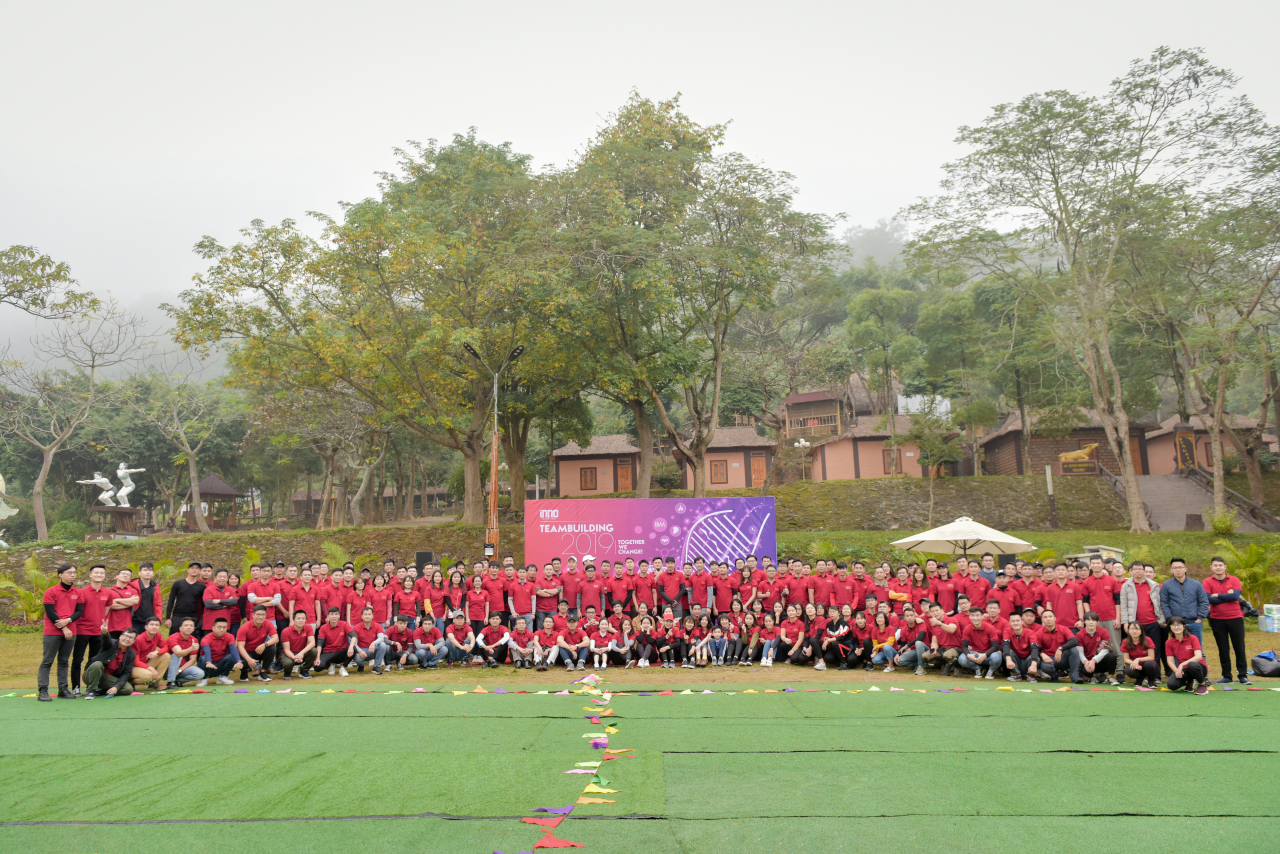
Established in 2008, and having undergone 13 years of development, INNO Joint Stock Company, with nearly 300 employees working in Hanoi and Ho Chi Minh City, along with approximately 200 employees in 10 affiliated companies (companies in which INNO co-founded and holds shares), proudly stands as one of the largest consulting companies in Vietnam and a business that consistently prioritizes the application of BIM in its design work.
INNO’s staff have participated in the implementation of numerous key projects of high scale and complexity. By the end of 2019, INNO had completed BIM training for 300 employees, and currently possesses the capability to implement BIM across various disciplines: architecture, structure, mechanical and electrical engineering, infrastructure, and fire protection. INNO also currently holds proprietary licenses for approximately 50 software programs supporting BIM implementation.
INNO is a consulting firm trusted by Vingroup to carry out pilot BIM implementation projects such as Vincity Ocean Park (up to BIM5D), Vinfast headquarters office, etc. To date, most contracts executed by INNO have applied BIM.
Some of INNO’s BIM-Applied Projects
The Seashell Aquarium BIM Model at Vinwonders Phu Quoc
With the operating philosophy: “Design consulting services are a process of providing services with a commitment to accompanying clients from start to finish in all circumstances,” INNO Joint Stock Company has gained the trust of clients, participating in the design of many large projects and becoming a strategic and reliable partner of major corporations such as: Vingroup, Sungroup, BRG, T&T, Doji, FLC, Bitexco, MIK,…
CHALLENGES AND SOME EXPERIENCES IN OVERCOMING THEM
Difficulties in staff training:
INNO understands very well that the entire company’s transition to using BIM is particularly difficult, and this process will inevitably have a significant impact on the company’s operational and production plans.
Regarding staffing, employees who already have to work hard to complete a large workload will now have to find additional time to participate in and complete the BIM training course. This is even more difficult for core staff members due to their busy schedules, requiring even greater effort. Training personnel accustomed to traditional methods to implement projects using BIM takes a considerable amount of time, sometimes a year, especially challenging when projects are in the acceleration phase with tight deadlines.
There are countless other difficulties that INNO’s architects and engineers have faced. They have repeatedly resolved to implement the transition, only to have it adjusted, and repeatedly interrupted after a period of determined training and conversion.
To achieve this, the company did not conduct widespread training, but focused on developing a core group, conducting in-depth research, and applying the technology to real-world production to identify and resolve problems. From one development group, it split into two groups, then three groups, and then transferred personnel from the BIM groups to the others. Simultaneously, widespread training was conducted to support the in-depth development. At the end of 2019, INNO required all employees who failed a mandatory company test to leave the company. Groups that successfully completed the transition were rewarded.
Difficulties in applying BIM to production:
Initially, few investors showed interest in BIM, so the number of BIM implementation projects was limited. INNO had to persistently persuade, train, and support investors to implement BIM. Currently, developers’ awareness of BIM has changed significantly. However, most partners and contractors involved in projects still work on traditional AutoCAD software, so BIM implementation still needs to accommodate those using CAD. This becomes even more difficult for projects that involve both design and construction and frequent changes. Most developers only accept BIM but haven’t implemented it yet, because BIM changes the way things are done. Dismantling old building systems and replacing them with new ones and processes takes time, and not all developers are ready to do it.
Implementing BIM significantly improves the quality of documentation, but the design time to produce the final product also increases considerably, while the cost that clients are willing to pay remains relatively unchanged. This situation is unlikely to change in the short term; however, INNO is currently persistently implementing BIM based on several perspectives, and initial results have been positive:
– Implementing BIM improves product quality. Once quality is improved, reputation is established, and market recognition increases, leading to better choices and enhanced design value.
– BIM is a crucial element in the digital transformation of businesses and serves as a foundation for leveraging technology to support, improve productivity, and scale up the enterprise.
Another challenge is the shortage of BIM managers with sufficient BIM knowledge and expertise. Discrepancies in understanding among different parties lead to lengthy discussions regarding product requirements and acceptance.